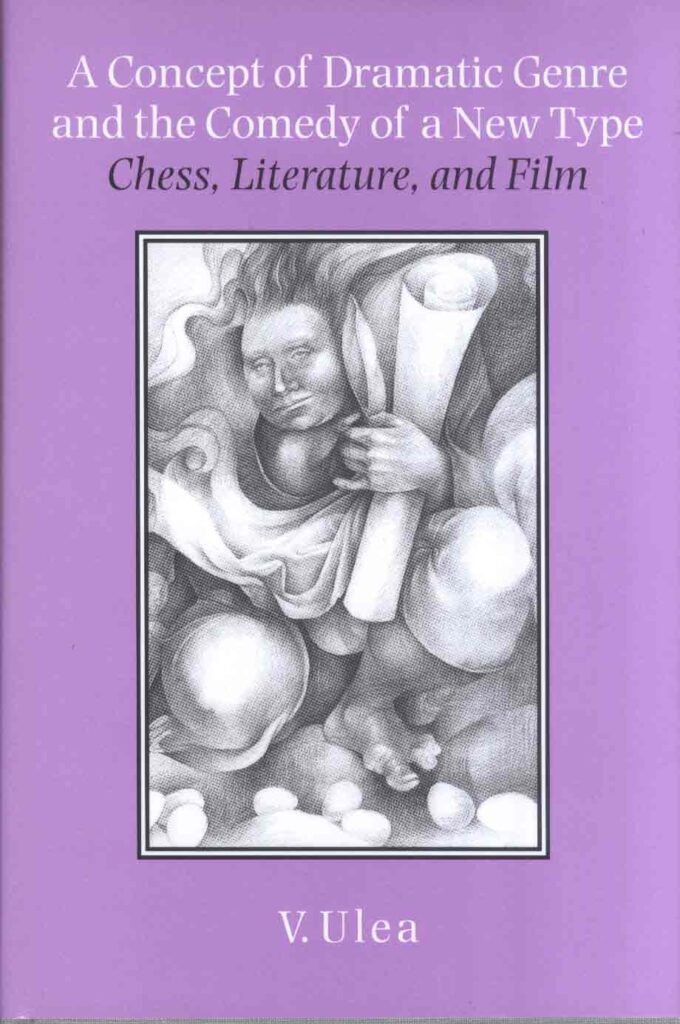
A Concept of Dramatic Genre and the Comedy of a New Type
REVEWS
V. Ulea attempts here a very ambitious thing, nothing less than a poetics of dramatic character as an alternative to the familiar, Aristotelian plot-based approach. She brings to her task a sophisticated understanding of human systems—organic, intelligent, capable of learning—and of their ability to interact creatively as psychological mechanisms in the best sense of the word: that is, as mechanisms for generating potentials. Chekhov, especially, will never quite sound the same.
Caryl Emerson, Professor of Russian literature and comparative literature in the department of Slavic Languages and Literature, P
rinceton University
___________
Ulea’s work is not only original and innovative, it is well argued and it is a most valuable contribution to the fields of dramatic and literary theory, especially to theories of the comic and comedy. It is one of the most creative, intellectually invigorating, and useful works of literary theory I have read in a long time.
Steven Totosy , Editor of
CLCWeb: Comparative Literature and Culture
“Dramatic genre deals with the potential of the artistic universe, which can be measured based on the methodology elaborated for indeterministic systems, taking into account the peculiarity of the artistic system when compared to other systems. I distinguish between three types of potential that correspond to three types of dramatic genre—dramedy, drama, and comedy.”
—V. Ulea, from the Preface
Applying systems theory to the comedies of Chekhov, Balzac, Kleist, Moliere, and Shakespeare, the book approaches dramatic genre from the point of view of the degree of richness and strength of a character’s potential. Its main focus is to establish a methodology for analyzing the potential from multidimensional perspectives, using systems thinking. The whole concept is an alternative to the Aristotelian plot-based approach and is applied to an analysis of western and eastern European authors as well as contemporary American film.
This innovative study consists of three parts: The first part is mostly theoretical, proposing a new definition of the dramatic as a category linked to general systems phenomena and offering a new classification of dramatic genre. In the second part, Ulea offers a textual analysis of some works based on this new classification. She analyzes comedies, tragedies, and dramas on the same or similar topics in order to reveal what makes them belong to opposite types of dramatic genre.
Additionally, she considers the question of fate and chance, with regard to tragedy and comedy, from the point of view of the predispositioning theory. In the third part, Ulea explores an analysis of the comedy of a new type—CNT. Her emphasis is on the integration of the part and the whole in approaching the protagonist’s potential. She introduces the term quasi-strong potential in order to reveal the illusory strength of protagonists of the CNT and to show the technique of CNT’s analysis and synthesis.
Ulea’s research begins with the notion of the comic, traditionally considered synonymous with the laughable, and attempts to approach it as independent from the laughable and laughter. The necessity to do so is dictated by the desire to penetrate the enigmatic nature of Chekhov’s comedy. The result is A Concept of Dramatic Genre and the Comedy of a New Type: Chess, Literature, and Film, a completely new approach to potential and systems thinking—which has never been a focus of dramatic theory before. Such potential is the touchstone of the comic and comedy, their permanent basic characteristic, the heart and axis around which the comedic world spins.
Published by Southern Illinois University Press
____________________________
Vera Zubarev, PhD is a literary critic, writer, poet, film director, and lecturer of Russian Language and Literature, Comparative Literature, and Literature and Business in the Department of Slavic Languages at the University of Pennsylvania. She is the author of 28 books of prose, poetry, and literary criticism.
PREFACE
This book is an attempt to approach dramatic genre from the point of view of the degree of richness and strength of a character’s potential. My main goal is to establish a methodology for analyzing the potential from a multidimensional perspective, using systems thinking. The whole concept is an alternative to the Aristotelian plot-based (externally motivated) approach, and it is applied to an analysis of western and eastern European authors and also to contemporary American film
This research touches on important questions linked to strategic thinking, decision making, and chaos and order; these are the basic notions forming the category of dramatic genre as approached from a nonorthodox perspective
The book consists of three parts. Part one is mostly theoretical, proposing a new definition of the dramatic as a category linked to the general systems phenomenon and offering a new classification of dramatic genre. In my classification, dramatic genre is divided into types (pure and mixed) and their variants and into branches (pure and mixed) and their variants. Basic types are defined by the characters’ potential, differing in degree of strength and richness, and are the following: comedy (limited and weak potential), dra-medy (rich and powerful potential), and drama (average/above average and strong potential). Basic branches are defined by types of outcome (successful, unsuccessful, and ambiguous) and by types of potential. All definitions of dramatic genre, including its types and branches, are given from a multidimensional perspective
In part two, I perform a textual analysis of some works based on this new classification. Comedies, tragedies, and dramas of the same or of similar topics undergo thorough analysis to reveal what makes them belong to opposite types of dramatic genre. In the process, I reconsider the traditional definitions of dramatic genre of some works in accordance with the new understanding of the notion of the dramatic as linked exclusively to the degree of richness and strength of characters’ potential. This part of the book also approaches the question of fate and chance, with regard to tragedy and comedy, from the point of view of the predispositioning theory. The goal of this analysis is to reveal what lies behind these notions and what methods of systems operation represent the category of fate and chance
Part three is occupied with the analysis of the comedy of a new type (CNT). This was first represented in works of Chekhov and Balzac; although these works were not funny, they were called comedies by their authors. In this part, the emphasis is on the integration of the part and the whole in approaching the protagonist’s potential. I introduce the term quasi-strong potential in order to reveal the illusory strength of protagonists of the CNT and to show the technique of its analysis and synthesis.
It is not my goal to perform textual analysis on every known work in this book—such a demand would be equal to plugging all existing notions into a formula to show how it would work in each particular case. It would not even be possible to mention all works worthy of critics’ attention; moreover, mere mentions would not be enough. There will always be disagreement concerning the importance of works included in and excluded from the analysis. I therefore decided to focus only on works that, in my opinion, are the most revealing examples of the given theoretical assertions. The technique of this analysis can be applied to any work that failed to be examined in this book
I would like to formulate my basic statements right at the beginning in order to orient the reader in the ocean of assertions and speculations formulating my concept.
This book is, first of all, an attempt to find a structure of dramatic genre, understanding by the dramatic a general core inherent in any type of literature, including prose and poetry, without regard to the question of their theatrical performance. Since any type of literary work can be perceived or subtitled as comic, tragic, dramatic, and the like, I distinguish between dramaturgy, whose specifics are linked to designing a work for theatrical performances, and dramatic genre, which is a constituent part of any literary work, including dramaturgy.
My basic assertion is that the dramatic is invariant to one’s emotional perception; it is independent from tears and laughter, contrary to what the Aristotelian school states with regard to the comic. The essential core of the dramatic is a potential that may evoke diverse emotional reactions from spectators. The notion of the dramatic therefore belongs to the general systems phenomenon and must be approached from the point of view of measurement of the degree of richness and strength of a potential of the artistic universe represented in a literary work
I began my research with the notion of the comic, traditionally considered synonymous with the laughable, and attempted to approach the concept as independent from the laughable and laughter. The necessity to do so was dictated by my own desire to penetrate the enigmatic nature of Chekhov’s comedy that in criticism has never been accepted as such. As a result of my inquiries into the structure of the comic, a more general question arose concerning the concept of dramatic genre comprising the comic and comedy along with its other types. This explains why, in discussing my concept of dramatic genre, I first and foremost refer to the comic and comedy as the most difficult and puzzling part of dramatic genre. I would venture to say that the treatment of the comic and comedy is the litmus test of credibility of any theory of dramatic genre, because if the theory sheds light on the other side of the “moon” (comedy), it will definitely work for the visible “landscape
Though the proportion of laughter seems to be greater in comedy than in tragedy or drama, and the happy ending or survival is a prerogative of traditional comedy, these characteristics cannot be considered sufficient in defining comedy and the comic. It is not laughter or survival that makes a literary work belong to the comedic genre but rather the weak, limited potential of its protagonists. Such potential is the touchstone of the comic and comedy, their permanent basic characteristic, the heart and axis around which the comedic world spins
Thus, my main argument is that dramatic genre deals with the potential of the artistic universe, which can be measured based on the methodology elaborated for indeterministic systems, taking into account the peculiarity of the artistic system when compared to other systems
As is mentioned above, I distinguish between three types of potential that correspond to three types of dramatic genre—dramedy, drama, and comedy. (The term dramedy will be explained later). It is implied here that the degree of the inner strength of the potential—its dual parameter—is in accord with the degree of its richness—its initial parameter. The dual parameter may not always be correlated with the initial parameter, however, which means that the outer strength of the entity—its position in the system—may differ from its inner strength, which is linked to its inner development. A disagreement between the inner and outer evaluations would cause the appearance of some new varieties of dramatic types and branches whose structure will be discussed in the next part of this book
The development of dramatic genre and appearance of its new types, such as Chekhov’s and Balzac’s comedy of a new type, sharpens the question of the theory of comedy, in particular, and of dramatic genre, in general. The inability to outline some specific features inherent in comedy of all types, including traditional comedy and the CNT, causes constant confusion of the dramatic nature of these works, which are sometimes called dramas, sometimes tragedies, and sometimes tragicomedies. Regardless of numerous valuable observations made by Aristotelian and neo-Aristotelian schools, the main question concerning the basic structure determining dramatic genre still remains unanswered. It becomes clear that innovations explicitly and deliberately introduced by the two masters of the CNT cannot be explained by traditional, mostly empirical, observations on the comic as linked primarily to the laughable
In discussing the comic, I refer to a concept independent of the notions of humor, joking, and laughter that have been previously investigated in criticism. The comic embodies the core of comedy; in my research, I separate the notions of the comic from all other assumptions about both amiable and mocking laughter. As will be illustrated, both laughter and lamentation can be present in any type of dramatic genre. Therefore, they must not be confused with core literary categories: the dramatic, the comic, and the tragic. These categories are based exclusively on the degree of strength and richness of the potential
Although some ideas concerning laughter and weeping will be discussed in subsequent chapters, these psychologies are not the focus of the present research. The emphasis of this book is on the structure, function, and processing of the potential of the artistic work and on methods of its measurement
In summary, I do not aim to deny the Aristotelian and neo-Aristotelian paradigm; however, I consider it insufficient in defining the comic and, accordingly, the tragic and the dramatic. In order to investigate this same notion, I propose not a subbranch of Aristotelian logic but a new theory that implies a complete separation of the comic from the laughable, in particular, and the dramatic from any emotional perception, in general. This notion represents a different epistemological methodology and requires measurement of potential. Therefore, in this work, I attempt to synthesize elements of existing literary methodologies that deal with character and to present a new methodology used for measurement of potential
V. Ulea (Vera Zubarev)
